


Wondering how quartz worktops are made? This article breaks down the step-by-step process from mining raw quartz to installing polished surfaces in your kitchen. Explore how everyday minerals transform into stylish and durable worktops.

Quartz worktops begin their journey deep within the earth, where natural quartz is extracted from specific deposits through open-pit or underground mining methods. Once mined, the quartz undergoes a thorough cleaning process using water and chemicals to remove any contaminants, ensuring that only the purest material proceeds to the next stage.
After cleaning, the journey continues as the quartz is transported to manufacturing facilities where it is processed into quartz slabs. This stage involves multiple steps, including:
The entire process of making quartz worktops —from quarrying to installation —requires meticulous attention to detail and advanced technology, including a stone-cutting workshop. It’s a fascinating journey that turns a raw, natural mineral into a sophisticated, functional centrepiece for your home.
Quartz is a natural mineral primarily composed of silicon dioxide (SiO2) and silica, forming under the intense heat and pressure of igneous rocks deep within the earth. As magma cools, silicon dioxide crystallises into pure quartz, forming hexagonal structures that are both strong and visually striking. Quartz minerals, among the most abundant, are an essential part of this process.
These quartz crystals can be found in a myriad of colours, ranging from vibrant purples and pinks to subtle whites and blacks, depending on the presence of various impurities and minerals. Understanding the natural formation and composition of quartz provides a deeper appreciation of the material’s beauty and durability, which are key characteristics of quartz worktops.
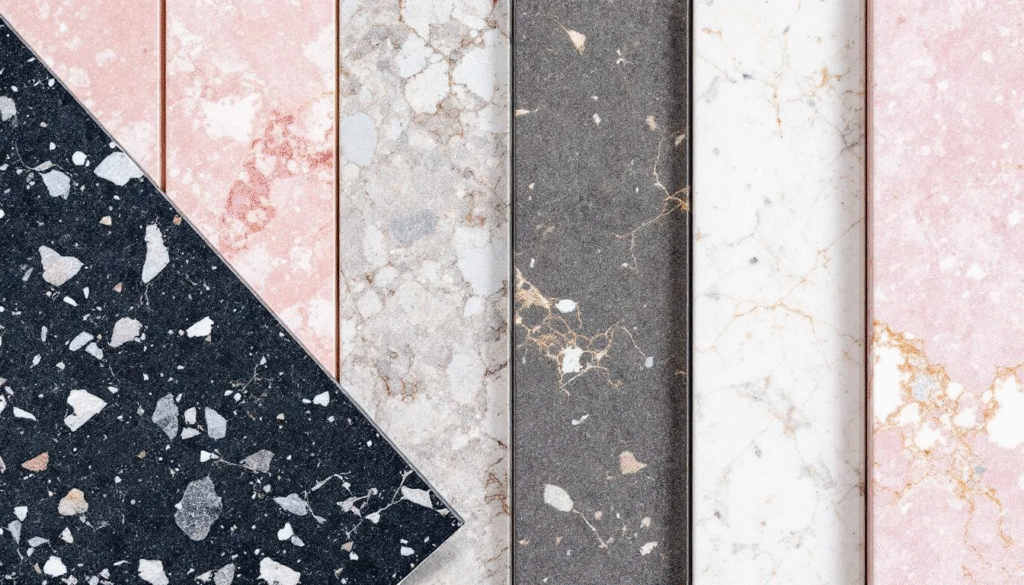
Quartz worktops are engineered stone surfaces composed of approximately 90-95% crushed natural quartz, combined with pigments and polymer resins. This blend not only enhances the durability and resilience of quartz worktops but also allows a wide range of colours and finishes, making quartz a versatile choice for any kitchen design. Additionally, a quartz countertop can provide the same benefits and aesthetic appeal as a countertop.
The process of creating quartz slabs involves bonding these components together using binding agents or resins, resulting in a non-porous, solid surface that is resistant to stains and scratches. This engineered composition sets quartz worktops apart from natural stones, offering superior performance and aesthetic flexibility.
The journey of creating quartz worktops begins with:
Following sorting, the quartz crystals are cleaned to remove any impurities and then crushed into finer particles, preparing them for the blending process. This preparation stage is crucial for maintaining the quality and consistency of the final product and for setting the foundation for the manufacturing process that follows.
In the blending stage, heavy-duty crushers break down the quartz rocks into smaller pieces before they are ground into uniform particles. This uniformity is critical for quality control, ensuring that the final product meets the high standards expected of quartz worktops.
The blending process involves:
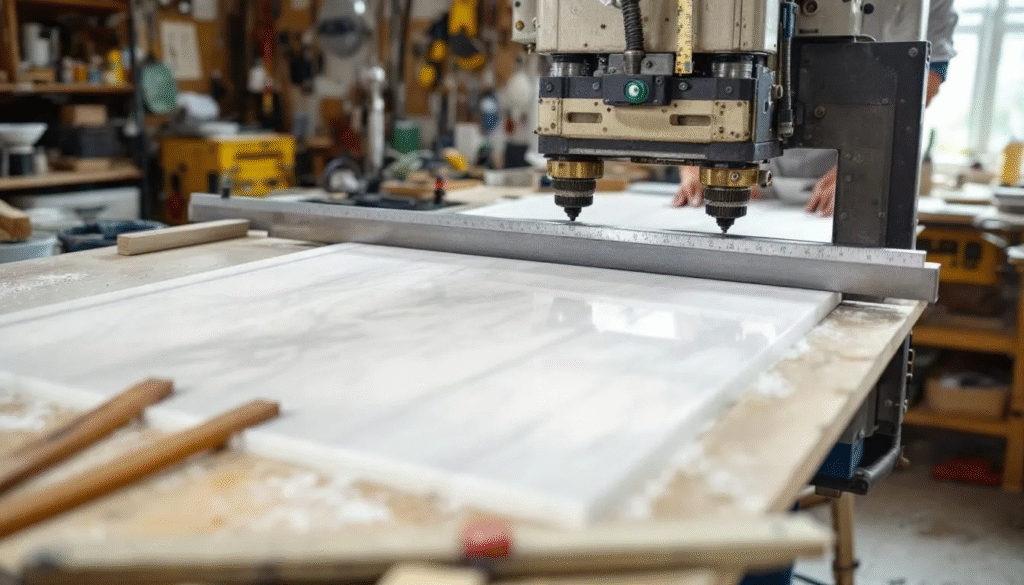
The manufacturing process of quartz worktops involves compressing and heating the blended mixture to form manufactured slabs. A vibro-compression technique is employed, subjecting the mixture to high-pressure and vacuum conditions to eliminate air bubbles and ensure a solid, durable slab. This method not only compacts the mixture but also contributes significantly to the non-porosity of the final product, making quartz worktops resistant to stains and easy to maintain.
The resulting quartz slabs are dense and solid surfaces free of voids, ready for the next stage of their journey. The vibro-compression process ensures that each slab is meticulously crafted to meet the highest standards of quality and durability, providing homeowners with a reliable and aesthetically pleasing surface for their kitchens.
After the vibro-compression step, the quartz slabs are placed in a heated curing kiln where:
The curing process is a critical step in ensuring the durability and heat resistance of the quartz worktops. By hardening the slabs under controlled conditions, the final product achieves the strength and resilience required for everyday kitchen use.
Once the quartz slabs have been cured, they are allowed to cool to ambient temperature, a crucial step for maintaining their structural integrity. This cooling process ensures that the slabs are formed, stable, and ready for the next steps.
During the trimming phase, any inconsistencies along the edges of the slabs are removed to create a uniform and standardised product. This step is essential to ensuring the slabs fit precisely when installed in kitchens, providing a seamless, professional finish.
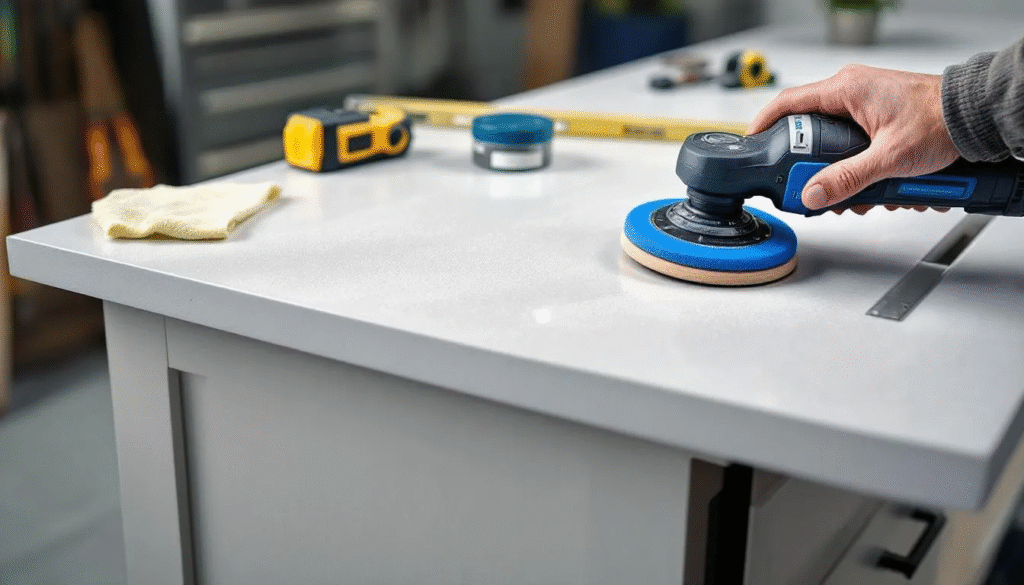
The surface finishing techniques applied to quartz slabs are what give them their final appearance and texture. While a high sheen is the primary finish for most quartz surfaces, manufacturers also offer options such as matte and textured finishes to cater to different aesthetic preferences.
The finishing process involves smoothing and buffing the polished surface, as well as inspecting it for quality. The addition of reflective minerals like mica can further enhance the aesthetic appeal of quartz surfaces, making them a striking addition to any kitchen.
Customisation is a key aspect of quartz worktops, allowing homeowners to tailor the design to their specific needs and preferences. The templating process is critical in ensuring precise measurements, which are then used to cut the quartz slabs to match the template exactly.
Special tools are essential for millimetre-precision cutting, ensuring that the edges of large slabs are perfectly trimmed and that the worktops fit correctly in their designated spaces, as specified by the manufacturer. Cut precisely with these tools; they guarantee optimal results.
The vast range of colours and styles available in quartz worktops means that there is something to suit every taste and desired colour kitchen design.

The installation of quartz worktops is a meticulous process that requires accurate templating and skilled installers. Advanced tools such as laser measuring devices are used to achieve precise measurements, ensuring that the worktop fits perfectly with various fixtures and kitchen layouts.
Before installing the quartz slab, the following steps are taken:
After setting the slab in place, the caulking needs several hours to dry before the worktop can be used.
One of the biggest advantages of quartz worktops is their low maintenance requirements. Cleaning quartz countertops is simple and only requires mild soap, water, and a soft cloth. Unlike granite and marble, quartz does not require annual sealing, making it easier to maintain.
Important precautions for caring for quartz surfaces include:
With proper care, quartz worktops can retain their beauty and functionality for many years.
Quartz worktops offer several significant advantages over natural stone options like granite worktops and marble. They are engineered for superior durability, providing higher resistance to scratches and stains. Unlike granite, which is a completely natural stone, quartz worktops are made from engineered stone, combining crushed natural stones with resins and pigments to create a uniform, reliable surface.
The variety of colours and styles available in quartz worktops offers greater design flexibility, making it easier to match them with other kitchen elements. Additionally, the low maintenance requirements and durability of quartz make it a practical and long-lasting choice for busy kitchens.
Exploring different quartz samples can be an inspiring step in designing your kitchen. With a wide selection of colours and finishes available, you can find the perfect match for your desired aesthetic.
Ordering samples allows you to see the quality and beauty of quartz worktops firsthand, helping you make an informed decision for your space.
The journey of transforming raw quartz into stunning kitchen worktops is a fascinating process that involves meticulous attention to detail and advanced technology. From the initial mining and preparation of raw materials to the blending, moulding, curing, and finishing stages, each step is crucial in creating durable and aesthetically pleasing quartz worktops.
Quartz worktops offer unmatched durability, low maintenance, and a vast range of design options, making them an excellent choice for modern kitchens. By understanding the process and proper maintenance, you can enjoy the beauty and functionality of quartz worktops for many years to come.
It is advisable to avoid placing hot pans directly on quartz surfaces, as doing so can lead to thermal shock that may result in cracks or discolouration, which typically are not covered by warranties.
Quartz worktops are manufactured by combining quartz grains, resins, and pigments using a vibro-compression technique to form large slabs, which are then cured at high temperatures in a kiln. This process ensures durability and a polished finish for the final product.
Quartz worktops are engineered surfaces composed of crushed quartz and resins, providing greater durability and design versatility than natural granite worktops. Consequently, quartz offers more consistent patterns and colours, making it a more customizable option for various aesthetics.
Quartz worktops require minimal maintenance; simply clean them with mild soap, water, and a soft cloth. They do not necessitate annual sealing, making them a practical choice for kitchens.
Quartz worktops can indeed be customised in a variety of colours and styles, allowing for precision cutting to ensure a perfect fit in your kitchen.


